The Importance of Artificial Intelligence in Real Life: How AI Is Changing the Way We Live
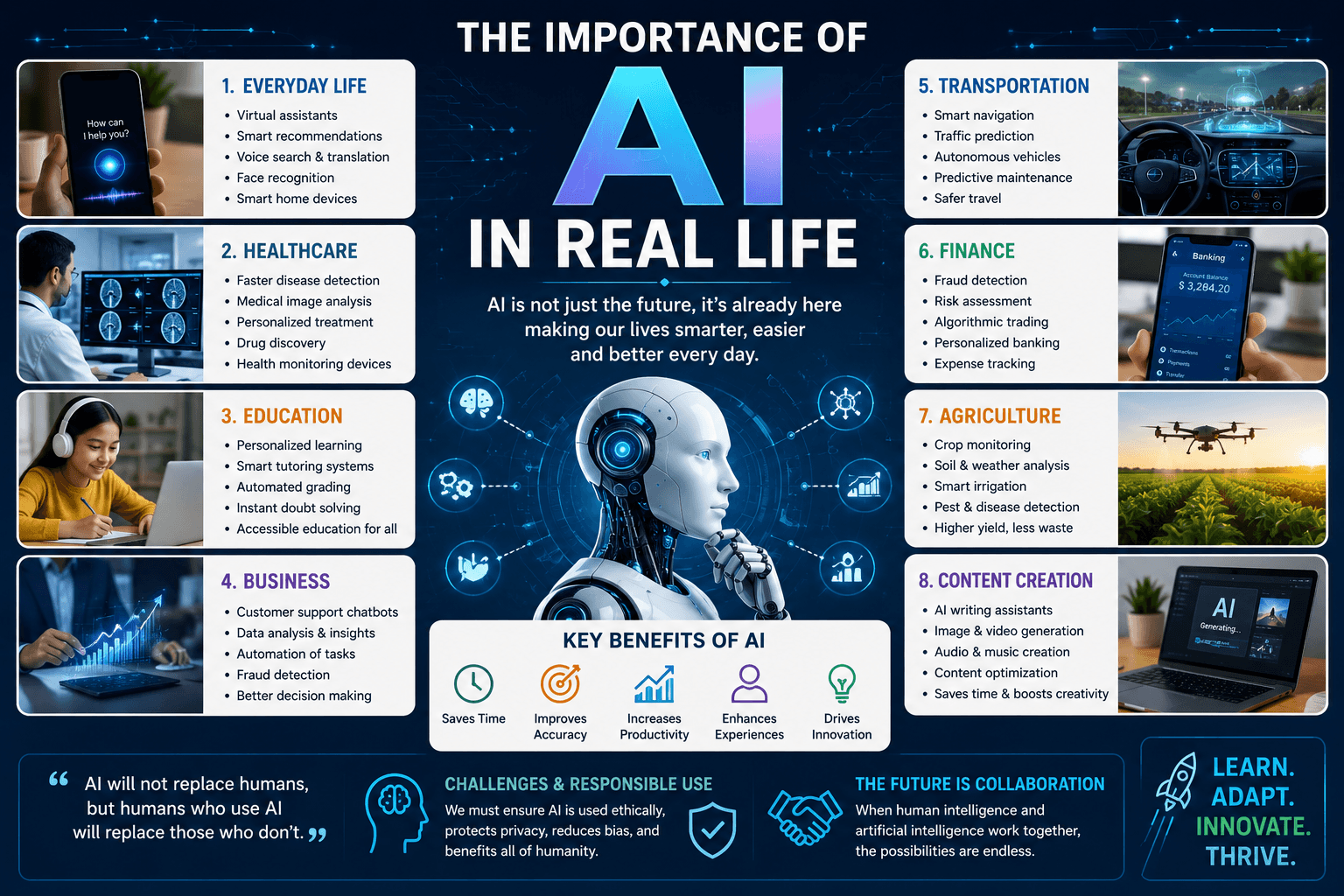
Artificial Intelligence (AI) is no longer just a futuristic idea from science fiction. It has become a part of our everyday lives, often working quietly in the background to make tasks easier, faster, and more efficient. Whether you're unlocking your smartphone with facial recognition, asking a virtual assistant for the weather, shopping online, or receiving personalized recommendations on your favorite streaming platform, AI is already influencing your daily routine.
As technology continues to evolve, AI is becoming one of the most important innovations of the 21st century. It is transforming industries, improving productivity, and creating opportunities that were unimaginable just a decade ago.
What Is Artificial Intelligence?
Artificial Intelligence refers to computer systems that can perform tasks that normally require human intelligence. These tasks include learning from data, understanding language, recognizing images, solving problems, making predictions, and even generating creative content.
Unlike traditional software that follows fixed instructions, AI learns from patterns and improves its performance over time, making it more adaptable to real-world situations.
AI in Everyday Life
Many people use AI without even realizing it.
When your phone suggests the next word while typing, AI is working. When a navigation app finds the fastest route, AI analyzes traffic data in real time. Online stores recommend products based on your interests, and streaming platforms suggest movies you'll likely enjoy. AI powers all of these experiences.
Smart home devices also rely on AI to control lighting, security systems, and household appliances using voice commands or automated routines.
AI in Healthcare
Healthcare is one of the industries benefiting most from AI.
AI helps doctors analyze medical images, identify diseases earlier, assist in diagnosis, and personalize treatment plans. Hospitals use AI to improve patient management, while researchers use it to accelerate drug discovery and analyze vast amounts of medical data.
Wearable devices powered by AI can monitor heart rate, sleep patterns, and physical activity, helping individuals maintain healthier lifestyles.
AI in Education
AI is transforming education by making learning more personalized and accessible.
Students can use AI-powered learning platforms to receive customized study plans, instant explanations, practice quizzes, and language support. Teachers can automate grading, create educational materials, and better understand student progress.
AI makes quality education more available to learners around the world.
AI in Business
Businesses use AI to improve efficiency, reduce costs, and deliver better customer experiences.
Customer support chatbots provide instant assistance around the clock. AI analyzes sales data, predicts market trends, manages inventory, detects fraud, and automates repetitive tasks.
Small businesses can compete more effectively by using AI tools for marketing, accounting, customer engagement, and content creation.
AI in Transportation
Modern transportation increasingly depends on AI.
Navigation apps optimize travel routes based on live traffic conditions. Logistics companies use AI to improve delivery efficiency, while vehicle manufacturers continue developing advanced driver-assistance systems and autonomous driving technologies.
AI contributes to safer and more efficient transportation systems.
AI in Content Creation
Content creators use AI to generate ideas, write articles, edit videos, design graphics, create music, and optimize content for search engines.
Rather than replacing creativity, AI often enhances it by handling repetitive tasks and allowing creators to focus on storytelling, strategy, and innovation.
AI in Finance
Banks and financial institutions rely on AI to detect fraudulent transactions, assess financial risks, automate customer support, and provide personalized financial recommendations.
AI also helps individuals manage budgets, track expenses, and make informed investment decisions.
AI in Agriculture
Farmers use AI to monitor crop health, predict weather patterns, optimize irrigation, and detect plant diseases early.
These technologies improve crop yields while reducing waste and conserving valuable natural resources.
Benefits of AI in Real Life
Artificial Intelligence offers numerous advantages:
Saves time by automating repetitive tasks.
Improves accuracy and reduces human error.
Increases productivity across industries.
Supports better decision-making through data analysis.
Personalizes user experiences.
Enhances accessibility for people with disabilities.
Drives innovation in science, medicine, and technology.
Creates new career opportunities and business models.
Challenges and Responsible Use
While AI offers significant benefits, it also raises important challenges.
Privacy and data security must be carefully protected. AI systems should be transparent, fair, and free from harmful bias. Human oversight remains essential, especially in healthcare, finance, education, and legal decision-making.
Responsible AI development ensures that technology benefits society while respecting ethical principles.
The Future of AI
The future of AI is incredibly promising.
As AI continues to evolve, we can expect smarter virtual assistants, personalized healthcare, more efficient transportation, intelligent manufacturing, advanced robotics, and new scientific discoveries.
People who learn to work alongside AI will be better prepared for the jobs and opportunities of the future. AI is not simply replacing work—it is changing how work is performed.
Conclusion
Artificial Intelligence has become an essential part of modern life. It improves the way we communicate, learn, work, travel, receive healthcare, and make decisions. From simple everyday conveniences to solving some of the world's biggest challenges, AI is helping shape a smarter and more connected future.
The true power of AI lies not in replacing human intelligence but in enhancing it. By combining human creativity, empathy, and critical thinking with the speed and analytical capabilities of AI, we can build a future that is more productive, innovative, and inclusive.
The future is not about humans versus AI—it is about humans and AI working together to create a better world.
0 Comments
Log in to leave a comment.