🇮🇳 India’s 80th Independence Day — The Journey from Struggle to Freedom
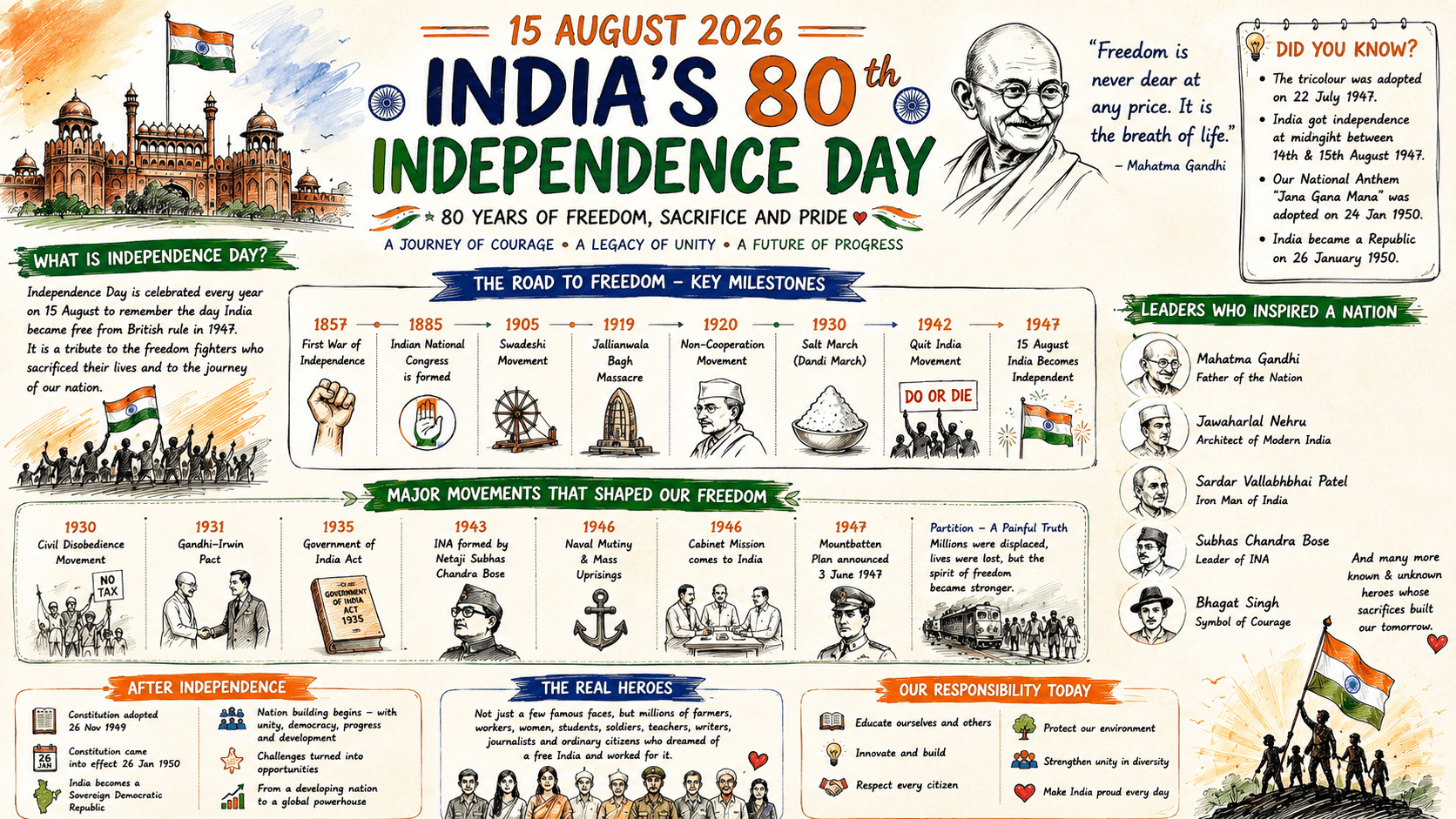
15 August 2026 is a historic day for India. Across the country, the Tricolour will rise, the national anthem will be heard, and millions of Indians will remember the extraordinary journey that brought the nation freedom.
India became independent on 15 August 1947, ending nearly two centuries of British colonial rule. The Government of India describes the transfer of power as the culmination of a long freedom struggle involving leaders, movements and ordinary citizens across the country.
2026 is officially observed as India's 80th Independence Day. One small distinction is worth remembering: India has completed 79 years of independence, but 15 August 2026 is the 80th Independence Day—just as a person's 80th birthday occurs after completing 79 years. The official Government of India material uses the “80th Independence Day” designation.
🇮🇳 What Does Independence Day Mean?
Independence Day is not simply another national holiday.
It is a day to remember:
The people who fought against colonial rule
Those who sacrificed their lives
The millions who participated in protests and movements
The leaders who negotiated India's future
The ordinary citizens whose names history may never record
The painful experience of Partition
The responsibility that came with freedom
The India we know today was not created in a single day.
15 August 1947 was the destination of a journey that lasted generations.
🌏 Before Independence: How British Rule Expanded
British involvement in India began primarily through the East India Company, which initially came for trade.
Over time, however, the Company expanded its political and military influence.
The Battle of Plassey in 1757 became an important turning point in the expansion of British political power in Bengal and beyond.
British control gradually expanded through military victories, political agreements, treaties and annexations.
The colonial system affected India's:
Economy
Agriculture
Trade
Industries
Administration
Political institutions
Social structures
As British power expanded, resistance also began to grow.
⚔️ 1857 — The Great Revolt
One of the most important early challenges to British rule came in 1857.
What began as a revolt among Indian soldiers of the East India Company's army spread to several regions, with farmers and civilians also becoming involved. Delhi became a major center of the rebellion, and Bahadur Shah Zafar became its symbolic leader.
Important figures associated with the uprising included:
Rani Lakshmibai
Bahadur Shah Zafar
Nana Sahib
Tantia Tope
Kunwar Singh
Begum Hazrat Mahal
Mangal Pandey
The revolt was eventually suppressed.
It did not bring independence.
But it left a lasting impact.
It demonstrated that resistance to British rule could emerge across different regions and communities. The Government of India's historical material describes 1857 as an important turning point and a source of inspiration for the freedom struggle that followed.
🏛️ 1885 — The Birth of Organized National Politics
The next major stage came with the formation of the Indian National Congress in 1885.
Early nationalist leaders initially focused on political representation, administrative reform and greater participation for Indians in government.
Among the important early leaders were:
Dadabhai Naoroji
Gopal Krishna Gokhale
Surendranath Banerjee
Bal Gangadhar Tilak
Lala Lajpat Rai
Bipin Chandra Pal
The political movement gradually changed.
The demand moved from reform toward self-government, and eventually toward complete independence.
The Congress became an important platform for organizing political activity across India.
🔥 1905 — The Swadeshi Movement
In 1905, the British decision to partition Bengal created widespread opposition.
The response became known as the Swadeshi Movement.
Its message was powerful:
Buy Indian. Boycott foreign goods.
Swadeshi was not merely about clothing or consumer choices.
It connected economic independence with political independence.
People promoted Indian-made products and boycotted British goods.
The movement helped spread nationalist consciousness and encouraged Indians to think about how economic dependence strengthened colonial rule.
🕊️ 1915 — Gandhi Returns to India
Mahatma Gandhi returned to India from South Africa in 1915.
He brought with him experience in organizing movements based on Satyagraha and non-violent resistance.
Gandhi gradually became one of the most influential figures in India's national movement.
His approach was revolutionary in one important way:
He brought ordinary people into the freedom struggle.
Farmers, workers, students, women, merchants and professionals could all participate.
The struggle was becoming a mass movement.
🩸 1919 — Jallianwala Bagh
The year 1919 became one of the darkest moments in India's freedom struggle.
Following opposition to the Rowlatt Act, tensions increased across the country.
On 13 April 1919, British troops under Brigadier-General Reginald Dyer opened fire on a gathering at Jallianwala Bagh in Amritsar.
The massacre shocked the country.
It became a major turning point in Indian public opinion and deepened opposition to British rule.
For many Indians, the event demonstrated the brutality of colonial power.
✊ 1920 — Non-Cooperation Movement
Gandhi launched the Non-Cooperation Movement in 1920.
The idea was simple but powerful:
If Indians refused to cooperate with colonial institutions, British authority would become harder to maintain.
People were encouraged to:
Boycott foreign goods
Leave certain government institutions
Boycott colonial educational institutions
Give up government honors
Promote Indian products
Participate in peaceful resistance
The movement brought large numbers of ordinary Indians into national politics.
It was eventually suspended following the Chauri Chaura incident in 1922, but its impact on India's political consciousness remained enormous. Government historical material identifies Non-Cooperation, Civil Disobedience and Quit India as three major mass movements associated with Gandhi's leadership.
🧂 1930 — The Salt March
Perhaps no object symbolized the power of ordinary people better than salt.
The British government controlled salt production and taxation.
In 1930, Gandhi decided to challenge the salt laws.
He began the famous Dandi March, walking from Sabarmati Ashram toward the coastal village of Dandi.
When Gandhi broke the salt law by making salt, a simple everyday product became a symbol of resistance.
The message was clear:
Colonial laws affected ordinary people, and ordinary people could challenge them.
The Salt March helped launch the broader Civil Disobedience Movement.
🇮🇳 The Freedom Struggle Was Bigger Than One Leader
It is important not to reduce India's independence movement to one person.
India's freedom struggle involved many ideologies, organizations, regions, communities and generations.
Mahatma Gandhi
Promoted non-violence, Satyagraha and mass civil resistance.
Jawaharlal Nehru
Advocated complete independence and played a major role in shaping India's political vision.
Sardar Vallabhbhai Patel
Played a major role in the nationalist movement and later in integrating princely states into independent India.
Subhas Chandra Bose
Believed that armed struggle could contribute to India's liberation and became associated with the Indian National Army.
Bhagat Singh
Inspired a generation of young Indians through his revolutionary ideas and sacrifice.
Sarojini Naidu
Was an important nationalist leader and participant in civil disobedience.
Aruna Asaf Ali
Became an important symbol of resistance during the Quit India Movement.
And there were thousands upon thousands of others.
Farmers. Students. Workers. Women. Tribal communities. Journalists. Lawyers. Soldiers. Teachers.
Many never became famous.
But they were part of the journey.
The Government of India's freedom-struggle materials specifically emphasize remembering lesser-known and unsung heroes whose sacrifices contributed to independence.
🪖 Subhas Chandra Bose and the Indian National Army
Subhas Chandra Bose followed a very different strategy from Gandhi.
He believed that India's independence could also be achieved through military struggle.
He became closely associated with the Indian National Army (INA) and the Provisional Government of Free India.
The INA's military campaign ultimately did not defeat British forces.
However, the INA became an important symbol of resistance.
After World War II, the INA trials attracted enormous public attention and contributed to the growing political pressure surrounding British rule.
The freedom struggle therefore had multiple dimensions:
Non-violent resistance.
Political negotiation.
Economic resistance.
Revolutionary movements.
Military resistance.
Mass mobilization.
🔥 1942 — Quit India Movement
Then came one of the final major mass movements.
On 8 August 1942, the All India Congress Committee launched the Quit India Movement in Bombay.
Gandhi gave the famous call:
“Do or Die.”
The demand was direct:
British rule must end.
British authorities responded by arresting major Congress leaders.
But the movement did not simply disappear.
Protests and underground activities continued in different parts of the country.
The Government of India's historical account describes Quit India as a major mass protest demanding an end to British rule and notes that independence followed five years after its launch, on 15 August 1947.
🌍 World War II Changed the Situation
World War II dramatically changed the global political environment.
Britain emerged from the war economically weakened.
At the same time, India's demand for independence had become impossible to ignore.
The British government attempted various negotiations, including the Cripps Mission, but these efforts did not resolve the fundamental political problem.
By the end of the war, the question was increasingly becoming:
Not “Will India become independent?”
but:
“How and when will power be transferred?”
🗳️ 1946 — The Final Political Negotiations
The Cabinet Mission came to India in 1946 to discuss the country's constitutional future and the transfer of power.
The political situation was extremely complicated.
Questions about:
Representation
Provincial autonomy
Federal structure
Minority rights
Muslim-majority provinces
The future relationship between different political groups
became central to negotiations.
Ultimately, political disagreements contributed to the decision to partition British India.
💔 Partition — The Pain Behind Independence
India's independence came with enormous human suffering.
British India was divided into two new Dominions:
🇮🇳 India
and
🇵🇰 Pakistan
Millions of people crossed newly created borders.
Families were separated.
Homes were abandoned.
Communities experienced horrific violence.
Many people lost their lives.
Therefore, remembering 15 August requires us to hold two emotions together:
❤️ The joy of freedom
and
💔 The tragedy of Partition.
Independence was a historic achievement, but 1947 was also a deeply painful chapter in the history of the subcontinent.
🇮🇳 15 August 1947 — Freedom Finally Arrives
After decades of struggle, India became independent on 15 August 1947.
Jawaharlal Nehru became independent India's first Prime Minister.
The Indian Tricolour was raised at the Red Fort.
The colonial era had ended.
India was finally responsible for its own future.
But there was another important realization:
Independence was not the end of the journey.
It was the beginning of nation-building.
The Government of India describes 15 August 1947 as the moment when political sovereignty was restored to the Indian people and the country began building its future around democratic ideals, unity and self-determination.
📜 From Independence to the Constitution
India now needed a system through which a huge and diverse population could govern itself.
The Constituent Assembly worked for years to create India's Constitution.
The Constitution was adopted on 26 November 1949 and came into force on 26 January 1950.
India became a Republic.
This was another extraordinary transformation.
India had moved from:
Colonial rule → Independence → Constitutional democracy.
🌱 The Difficult Work After 1947
Independent India inherited enormous challenges.
The country had to address:
Poverty
Illiteracy
Food security
Refugee rehabilitation
Infrastructure
Economic development
Healthcare
Education
Industrialization
Integration of princely states
Democratic institution-building
The task was enormous.
Yet India began building.
Schools expanded.
Universities developed.
Industries were established.
Scientific institutions grew.
Agricultural production increased.
Infrastructure expanded.
Democratic elections became a central part of national life.
🚀 India's Journey Into the Future
Today, India is very different from the country that emerged in 1947.
India has developed capabilities in:
🚀 Space technology
💻 Information technology
🤖 Artificial intelligence
🏭 Manufacturing
🧬 Biotechnology
📱 Digital payments
🌱 Renewable energy
🎓 Education and research
🚗 Automobile and mobility technology
🌍 Global business and entrepreneurship
The journey is far from complete.
India still faces challenges.
But that is exactly what makes Independence Day meaningful.
A nation is not built in one generation.
Every generation receives the responsibility of building what comes next.
🇮🇳 What Does Freedom Mean in 2026?
In 1947, freedom meant liberation from colonial rule.
In 2026, freedom also means creating opportunities for every citizen to build a better life.
Freedom means:
📚 Education
Every child should have the opportunity to learn.
💼 Opportunity
Young people should have opportunities to build careers and businesses.
💡 Innovation
India should encourage people to create rather than simply consume.
⚖️ Justice
Citizens should be treated with dignity and equality under the law.
🌱 Responsibility
Development should not destroy the environment.
🤝 Unity
Differences should not prevent Indians from working together.
🇮🇳 Citizenship
Freedom comes with responsibility.
👨💻 The Responsibility of Young India
Perhaps the biggest question for today's generation is:
What will we do with the freedom we inherited?
The freedom fighters of the past fought colonial rule.
Our generation faces different challenges.
We need to fight:
Ignorance with education.
Poverty with opportunity.
Unemployment with skills and entrepreneurship.
Misinformation with knowledge.
Environmental damage with responsibility.
Technological challenges with innovation.
Division with understanding.
A student studying late at night.
A developer building a new product.
A farmer adopting new technology.
An entrepreneur creating jobs.
A scientist working on a new discovery.
A teacher educating children.
A citizen helping their community.
All of these can contribute to the next chapter of India's story.
🇮🇳 80th Independence Day — Why It Matters
On 15 August 2026, we are not simply celebrating a number.
We are remembering a journey.
A journey that began with resistance.
A journey that passed through revolts, political awakening, Swadeshi, mass movements, Satyagraha, Civil Disobedience, revolutionary activity, the INA, Quit India and years of negotiations.
And finally:
15 August 1947.
Freedom.
The Government of India's historical resources describe the freedom struggle as a journey involving major milestones and many celebrated as well as lesser-known contributors.
❤️ A Message for Every Indian
When you see the Tricolour flying this Independence Day, remember that behind it are millions of stories.
Some are famous.
Many are forgotten.
Some are written in history books.
Others survived only through families and communities.
But together they created something extraordinary.
A free India.
The people who fought for independence could not know exactly what India would look like decades later.
They could only hope that future generations would have the freedom to decide their own destiny.
Today, we are that future generation.
And now the responsibility is ours.
🇮🇳 The Next Freedom Struggle Is Ours
The freedom struggle of the past was about breaking the chains of colonial rule.
The challenge of today is different.
We must build a country where freedom creates:
Opportunity.
Education.
Innovation.
Dignity.
Equality.
Prosperity.
Peace.
Progress.
India's story did not end on 15 August 1947.
It began a new chapter.
And in 2026, we are the authors of that chapter.
So this Independence Day, let us not only ask:
“What did our freedom fighters do for India?”
Let us also ask:
“What are we doing for the India that comes after us?”
Because the best way to honor the sacrifices of the past is to build a better future.
🇮🇳 Happy 80th Independence Day, India!
Let us remember the sacrifice.
Let us celebrate the freedom.
Let us protect the unity.
Let us build the future.
Jai Hind! 🇮🇳
— Margin Notes
0 Comments
Log in to leave a comment.