How to Become a Full-Stack Developer in the AI World
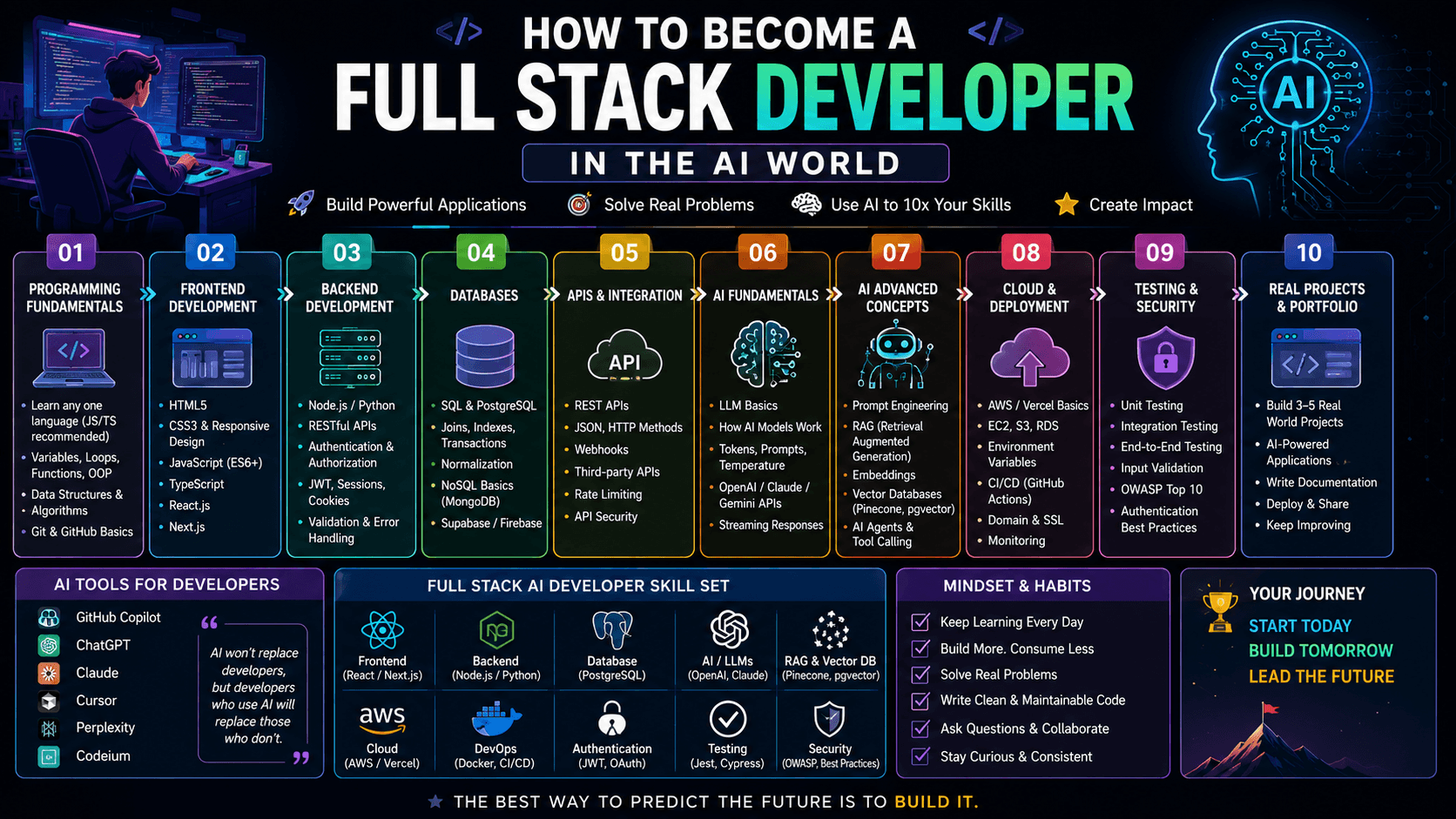
The definition of a Full-Stack Developer is changing.
A few years ago, becoming a full-stack developer mainly meant learning frontend development, backend development, databases, APIs, authentication, deployment, and cloud infrastructure.
Today, that foundation is still important.
But there is a new layer:
Artificial Intelligence.
Modern developers are no longer just writing code. They are using AI to understand problems, generate code, debug applications, design systems, analyze data, automate workflows, and build intelligent products.
The opportunity is enormous.
But it also creates a new challenge:
What should you actually learn to become a full-stack developer in the AI era?
The answer isn't "learn everything."
It's to build a strong foundation, then learn how to combine software engineering with AI.
- First Understand What a Modern Full-Stack Developer Does
A traditional full-stack developer works across:
Frontend → Backend → Database → APIs → Deployment
An AI-enabled full-stack developer adds:
AI Models → LLM APIs → RAG → AI Agents → Vector Search → AI-powered features
So your skill stack starts looking like:
Full-Stack AI Developer
│
┌─────────────────┼─────────────────┐
│ │ │
Frontend Backend AI
│ │ │
React/Next.js Node/Python LLMs
HTML/CSS APIs RAG
JavaScript Databases Embeddings
TypeScript Auth AI Agents
│ │ │
└─────────────────┼─────────────────┘
│
Cloud
│
AWS / Vercel
│
DevOps
You don't need to master all of these on day one.
You build them progressively.
- Start With Programming Fundamentals
Before jumping into AI frameworks, learn how to program properly.
You should understand:
Variables
Data types
Conditions
Loops
Functions
Arrays
Objects
Classes
Error handling
Modules
APIs
Asynchronous programming
Data structures
Basic algorithms
Git and GitHub
Which programming language?
For a modern AI-focused full-stack career, I'd recommend:
JavaScript/TypeScript + Python
JavaScript/TypeScript is excellent for full-stack web development.
Python is extremely important for AI, machine learning, automation, and data-related work.
You don't need to become an expert in both immediately.
Start with one.
Then add the second.
- Master HTML, CSS and JavaScript
Many beginners want to jump directly into React.
Don't rush.
Understand the fundamentals first.
HTML
Learn:
Semantic HTML
Forms
Tables
Accessibility
SEO basics
Page structure
CSS
Learn:
Flexbox
Grid
Responsive design
Animations
Positioning
Media queries
Modern layouts
JavaScript
Learn:
DOM
Events
Functions
Objects
Arrays
Promises
Async/await
Fetch API
Modules
JSON
Error handling
JavaScript is not just a frontend language.
It can power your entire application.
- Learn TypeScript
Once you're comfortable with JavaScript, learn TypeScript.
TypeScript helps you build larger applications with fewer mistakes.
Learn:
Types
Interfaces
Generics
Type aliases
Unions
Enums
Type narrowing
Utility types
Function types
For professional development, TypeScript is one of the most valuable skills you can add to your JavaScript stack.
- Learn React and Next.js
React is one of the most important frontend technologies to understand.
Learn:
Components
Props
State
Hooks
Forms
Context
API calls
Client/server concepts
Component architecture
Then move into Next.js.
Next.js allows you to build much more complete applications.
Learn:
App Router
Server Components
Client Components
Server Actions
API routes
Middleware
Authentication
Metadata
SEO
Image optimization
Caching
Deployment
For someone building products like a publishing platform, SaaS application, AI tool, or marketplace, this combination is extremely useful.
- Learn Backend Development
A full-stack developer cannot depend entirely on frontend code.
You need to understand what happens behind the application.
Learn:
REST APIs
HTTP
Request/response lifecycle
Authentication
Authorization
Sessions
Cookies
JWT
Validation
Error handling
Rate limiting
Logging
You can use:
Node.js + TypeScript
or
Python + FastAPI
Both are excellent.
If your primary goal is web development, Node.js is a natural extension of your JavaScript/TypeScript skills.
If you're heavily focused on AI and data, Python becomes increasingly important.
- Learn Databases Properly
Don't just learn how to create a table.
Understand databases.
Start with:
PostgreSQL
Learn:
Tables
Relationships
Primary keys
Foreign keys
Indexes
Joins
Transactions
Constraints
Views
Aggregations
Query optimization
Then understand:
NoSQL
Learn the basic concepts behind databases such as MongoDB.
You don't necessarily need five different databases.
Master one relational database first.
- Learn Supabase
If you're building modern web applications quickly, Supabase can be extremely useful.
It provides tools around:
PostgreSQL
Authentication
Storage
APIs
Realtime functionality
Row Level Security
For example, a publishing platform can use Supabase for:
Users
Posts
Categories
Tags
Comments
Likes
Bookmarks
Followers
Notifications
Analytics
The important lesson isn't simply learning the Supabase dashboard.
Learn PostgreSQL and backend architecture underneath it.
That knowledge transfers to other platforms.
- Learn APIs
Modern applications are connected through APIs.
You should understand how to:
Frontend
↓
API
↓
Backend
↓
Database
And with AI:
User
↓
Frontend
↓
Backend
↓
AI API
↓
LLM
↓
Response
↓
User
Learn how to work with:
REST
JSON
Authentication
API keys
Webhooks
Rate limits
Error handling
Pagination
Streaming responses
10. Now Learn Artificial Intelligence
This is where the modern full-stack developer becomes different.
You don't necessarily need to become a machine-learning researcher.
You need to understand how to build applications using AI.
Start with:
Large Language Models
Understand:
Tokens
Context windows
Prompting
System instructions
Temperature
Structured outputs
Function/tool calling
Streaming
Model selection
Then learn how to integrate LLM APIs into applications.
- Learn Prompt Engineering
Prompt engineering is useful, but don't make it your entire career strategy.
Instead of simply learning:
"How do I write a good prompt?"
learn:
"How do I design a reliable AI system?"
Understand:
System prompts
Few-shot examples
Structured output
Context management
Prompt templates
Evaluation
Guardrails
Tool calling
A strong developer doesn't just ask an AI model a question.
They build a system around the model.
- Learn RAG
One of the most important concepts for AI application developers is Retrieval-Augmented Generation, commonly called RAG.
Imagine you want to build an AI assistant for a company.
The AI model doesn't automatically know the company's private documents.
RAG allows you to retrieve relevant information and provide it to the model.
The basic flow:
Documents
↓
Split into chunks
↓
Create embeddings
↓
Store vectors
↓
User asks question
↓
Search relevant information
↓
Send context to LLM
↓
Generate answer
RAG is extremely useful for:
Document assistants
Knowledge bases
Customer support
Research tools
Internal company search
PDF assistants
Educational applications
13. Learn Embeddings and Vector Databases
To understand RAG properly, learn embeddings.
An embedding represents information as numbers that capture semantic relationships.
For example:
"How do I reset my password?"
and
"I forgot my login credentials."
may have different words but similar meaning.
Vector search can help identify that relationship.
Learn concepts such as:
Embeddings
Similarity search
Vector indexing
Metadata filtering
Chunking
Retrieval
Hybrid search
You can explore technologies such as:
pgvector
Pinecone
Weaviate
Qdrant
You don't need to learn all of them.
Learn the concept first.
- Learn AI Agents
The next step is moving beyond simple chatbots.
An AI agent can:
Understand a goal
Plan actions
Use tools
Retrieve information
Execute tasks
Evaluate results
Continue until the task is completed
For example:
User:
"Find my unpaid invoices and prepare a summary."
Agent
↓
Search database
↓
Identify unpaid invoices
↓
Calculate totals
↓
Generate summary
↓
Return result
This is where software engineering becomes extremely important.
The AI model is only one part of the system.
- Learn AI + Database Integration
This is a powerful combination.
Imagine your application has:
Users
Invoices
Customers
Employees
Products
Orders
Documents
Instead of forcing users to navigate through dashboards, you could allow them to ask:
"Show me all unpaid invoices from last month."
The system can translate the request into a controlled database operation.
The future isn't just:
Chatbots.
It's:
AI interacting with real software systems.
- Learn Authentication and Security
AI doesn't remove traditional security requirements.
You still need to understand:
Authentication
Authorization
Password security
OAuth
Sessions
JWT
API key protection
SQL injection
XSS
CSRF
Rate limiting
Input validation
Secure file uploads
Secrets management
If you're using Supabase, learn Row Level Security properly.
Never trust the frontend to enforce permissions.
- Learn Git and GitHub
Git is not optional for professional developers.
Learn:
git clone
git status
git add
git commit
git push
git pull
git branch
git merge
git rebase
Also understand:
Pull requests
Code reviews
Branch strategies
Commit messages
Merge conflicts
GitHub Actions
Your GitHub profile can also become part of your professional portfolio.
- Learn Cloud Computing
You don't need to become a cloud architect immediately.
But understand:
Servers
Containers
Networking
DNS
CDN
Storage
Databases
Load balancing
Monitoring
Environment variables
Secrets
Then learn one major cloud platform.
AWS
Learn the fundamentals of:
EC2
S3
Lambda
RDS
CloudFront
IAM
VPC
CloudWatch
You don't need to memorize every AWS service.
Understand what problems the services solve.
- Learn Docker
Docker helps you package your application and its dependencies into a consistent environment.
Understand:
Application
+
Dependencies
+
Runtime
+
Configuration
↓
Container
Learn:
Images
Containers
Dockerfile
Docker Compose
Volumes
Networks
Environment variables
Docker becomes especially useful when moving from simple deployments to more complex infrastructure.
- Learn Testing
AI-generated code makes testing even more important.
Don't blindly trust generated code.
Learn:
Unit testing
Test individual functions.
Integration testing
Test how components work together.
End-to-end testing
Test the application from the user's perspective.
For AI applications, also learn:
AI evaluation
Ask:
Did the model answer correctly?
Did it hallucinate?
Did it follow instructions?
Did it use the correct tool?
Did it retrieve the right documents?
Is the response safe?
AI applications require a different kind of testing discipline.
- Learn How to Use AI as a Developer
This is one of the biggest changes.
AI coding tools can help you:
Generate code
Explain unfamiliar code
Debug errors
Write tests
Refactor code
Create documentation
Generate SQL
Design APIs
Review pull requests
Brainstorm architecture
But there is a dangerous mistake:
Don't become a copy-paste developer.
If AI generates code you don't understand, you haven't really learned the skill.
Use AI as:
Teacher + pair programmer + reviewer + assistant
not:
replacement for thinking.
- Learn Software Architecture
As your projects become larger, architecture becomes more important.
Understand:
Separation of concerns
Modular architecture
Service layers
API layers
Database layers
Caching
Queues
Background jobs
Event-driven systems
Microservices
But don't start every project with microservices.
For most early-stage products:
A well-structured monolith is often better.
Start simple.
Scale when necessary.
- Build Real Projects
This is where your learning becomes valuable.
Don't build only:
Calculator
To-do list
Weather app
Build projects that demonstrate real-world engineering.
Project 1 — AI Writing Assistant
Features:
Authentication
Editor
AI generation
AI rewriting
Saving drafts
Publishing
Database
Project 2 — AI PDF Assistant
Features:
PDF upload
Document processing
Embeddings
RAG
Chat interface
Source references
Project 3 — AI Finance Dashboard
Features:
Transactions
Invoices
Expenses
Reports
Charts
AI financial insights
Project 4 — AI Recruitment Platform
Features:
Candidate profiles
Resume upload
Resume parsing
Job matching
Search
AI candidate summaries
Project 5 — Full Publishing Platform
Build something similar to your current project.
Include:
User profiles
Authors
Posts
Categories
Tags
Comments
Likes
Bookmarks
Followers
Search
Recommendations
AI writing assistance
Analytics
This single project can demonstrate a huge portion of your full-stack skills.
- Build a Portfolio, Not Just a Resume
A strong AI full-stack portfolio should demonstrate what you can build.
For each project, show:
Problem
What problem did you solve?
Solution
How does your application solve it?
Technology
What did you use?
Architecture
How does the system work?
AI
Where does AI fit?
Challenges
What problems did you encounter?
Results
What did you achieve?
A live application is even better.
- A Practical Learning Roadmap
You don't need to learn everything simultaneously.
Phase 1 — Programming
1–2 months
JavaScript/TypeScript fundamentals
Git/GitHub
HTML/CSS
Basic algorithms
Phase 2 — Frontend
1–2 months
React
Next.js
Tailwind
API integration
Responsive design
Phase 3 — Backend
1–2 months
Node.js
REST APIs
Authentication
PostgreSQL
Supabase
Phase 4 — Cloud
1 month
AWS fundamentals
Deployment
Docker
CI/CD
Monitoring
Phase 5 — AI Development
2–3 months
LLMs
Prompt engineering
AI APIs
RAG
Embeddings
Vector databases
Tool calling
AI agents
Phase 6 — Advanced Projects
Ongoing
Build production-quality applications.
- What Your Final Skill Stack Could Look Like
A strong AI-focused full-stack developer could have:
Frontend
├── HTML
├── CSS
├── JavaScript
├── TypeScript
├── React
└── Next.js
Backend
├── Node.js
├── APIs
├── Authentication
└── Backend architecture
Database
├── PostgreSQL
├── SQL
├── Supabase
└── Vector search
AI
├── LLM APIs
├── Prompt engineering
├── RAG
├── Embeddings
├── Tool calling
└── AI agents
Cloud
├── AWS
├── Vercel
├── Docker
└── CI/CD
Engineering
├── Git
├── Testing
├── Security
├── Performance
└── System design
You don't need to master every item.
You need to become strong in the fundamentals and capable of building with the rest.
- The Most Important Skill: Problem Solving
Technology will keep changing.
Today's popular framework may not be tomorrow's.
Today's AI model will eventually be replaced.
New tools will appear.
New programming languages will become popular.
But problem-solving will remain valuable.
When someone gives you a problem, you should be able to think:
What is the actual problem?
↓
What does the user need?
↓
What architecture makes sense?
↓
What data do I need?
↓
What APIs do I need?
↓
Where can AI help?
↓
How do I secure it?
↓
How do I test it?
↓
How do I deploy it?
That mindset is much more valuable than memorizing hundreds of technologies.
- Don't Compete With AI — Learn to Build With It
There is a lot of fear that AI will replace developers.
AI will certainly change software development.
Some repetitive coding tasks will become easier.
Developers who only know how to write basic code may face more competition.
But developers who understand:
Business + Software + AI + Architecture + Problem Solving
will have an enormous advantage.
The goal isn't to compete against AI by typing code faster.
The goal is to become the person who knows what should be built, why it should be built, how it should work, and how to use AI to build it better.
- Your 12-Month Goal
If you're starting today, don't make your goal:
"I want to learn 20 technologies."
Make your goal:
"I want to build and deploy real AI-powered applications."
By the end of your learning journey, aim to have:
3–5 serious projects
A professional GitHub profile
A personal portfolio
At least one AI-powered application
Strong JavaScript/TypeScript fundamentals
Strong SQL fundamentals
Working knowledge of Python
React/Next.js experience
Backend/API experience
Cloud fundamentals
AI API integration experience
RAG experience
Deployment experience
Testing and security knowledge
That portfolio will tell a much stronger story than a list of certificates.
Final Thoughts
The AI era doesn't mean the end of full-stack development.
It means full-stack development is evolving.
The developer of the future won't simply write frontend code or backend code.
They will understand the entire product.
They will know how users interact with software.
They will understand databases and APIs.
They will deploy applications to the cloud.
They will use AI models intelligently.
They will build RAG systems and AI agents.
They will understand security.
They will test their systems.
And most importantly, they will know how to solve problems.
So don't try to learn everything at once.
Start with programming.
Build your frontend foundation.
Learn backend development.
Master databases.
Learn cloud fundamentals.
Then add AI.
Build real products.
Use AI to accelerate your learning.
And keep improving.
The future belongs to developers who can combine software engineering with intelligence.
Learn the fundamentals.
Build real things.
Use AI wisely.
Keep learning.
Keep shipping.
Because in the AI world, the most valuable developer may not be the person who writes the most code.
It may be the person who can turn an idea into a working product.
0 Comments
Log in to leave a comment.