You Don’t Need to Know Everything — You Just Need to Keep Learning
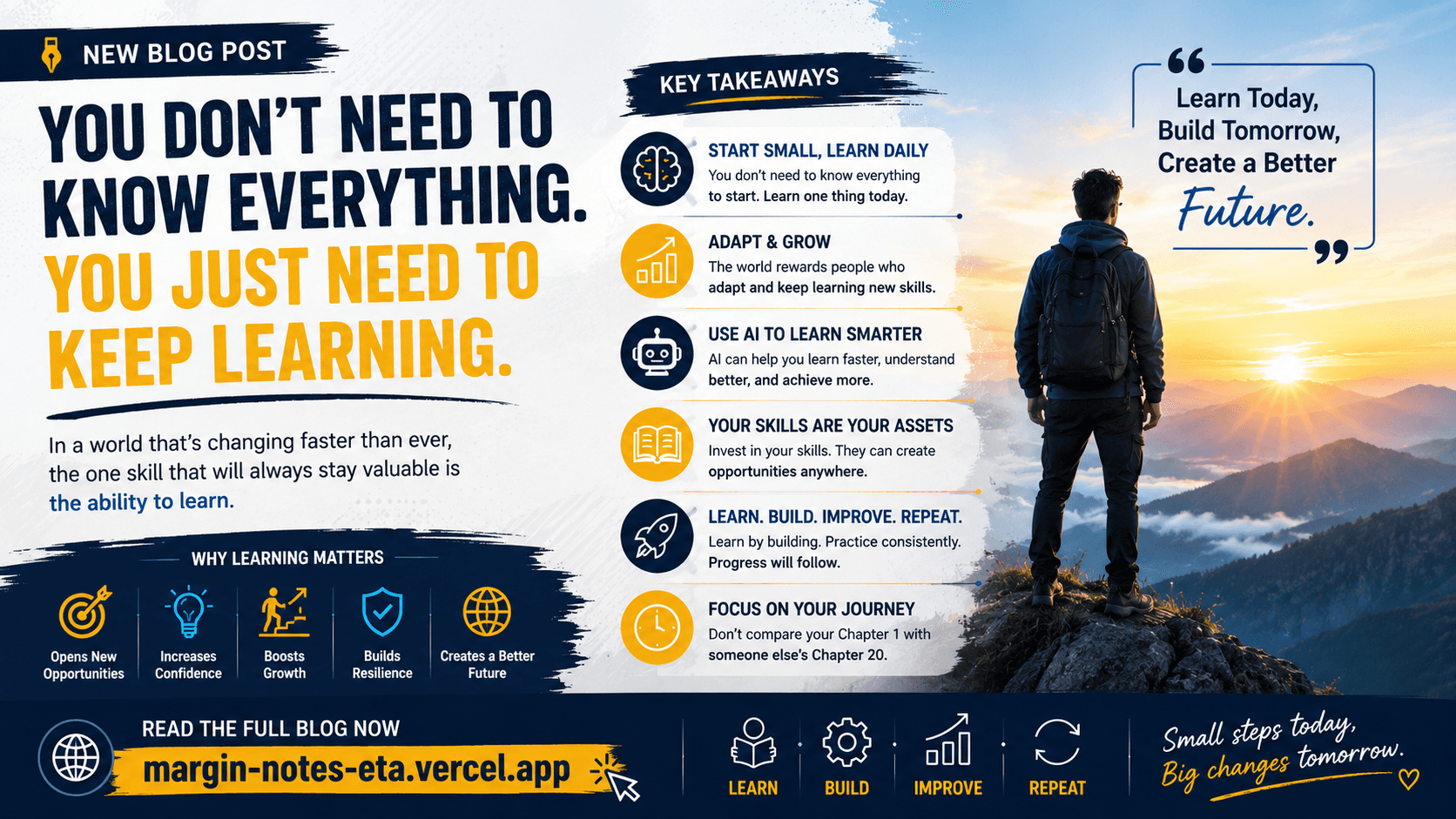
There was a time when knowing one skill could define your entire career.
You could learn accounting, programming, marketing, engineering, or design—and spend decades becoming better at the same thing.
Today, the world is different.
Technology changes quickly. Artificial Intelligence is transforming the way we work. New tools appear every week. Jobs are evolving, businesses are changing, and skills that were valuable yesterday may not be enough tomorrow.
But there is one skill that never becomes outdated:
The ability to learn.
You Don't Have to Know Everything
One of the biggest mistakes people make is believing they need to know everything before they start.
They don't.
You don't need to become an AI expert before using AI.
You don't need to be a professional programmer before building your first website.
You don't need to understand business completely before starting a business.
And you don't need to have your entire life figured out before taking the next step.
You simply need to learn one thing at a time.
Start small.
Learn something today that you didn't know yesterday.
Then repeat it tomorrow.
That's how progress happens.
The World Rewards People Who Adapt
Imagine two people starting their careers at the same time.
Person A learns one skill and stops.
Person B keeps learning.
Five years later, Person B knows how to use new technologies, understands modern tools, communicates better, and has developed several additional skills.
The difference isn't necessarily intelligence.
It's adaptability.
The world doesn't always reward the person who knows the most.
It often rewards the person who can learn, adapt, and apply knowledge quickly.
AI Has Changed the Learning Game
Artificial Intelligence has made learning more accessible than ever.
You can now ask an AI assistant to explain a difficult concept in simple language, create examples, review your work, help you practice, generate ideas, or guide you through a project.
Imagine wanting to learn programming.
Previously, you might need several books, courses, and hours of searching for answers.
Today, you can build something and ask AI:
“Explain why this isn't working.”
Then you can learn from the answer.
But there's an important difference:
Don't use AI only to get answers. Use AI to learn how to find answers.
The goal shouldn't be to become dependent on technology.
The goal should be to become better because of technology.
Your Skills Are Your Real Assets
Money can be lost.
Businesses can fail.
Jobs can disappear.
Markets can change.
But the knowledge and skills you develop stay with you.
If you learn:
Communication
Technology
AI
Programming
Marketing
Financial management
Leadership
Problem-solving
Critical thinking
Creativity
you are building assets that can create opportunities again and again.
Your skills can help you find a job.
They can help you start a business.
They can help you create a product.
They can help you work remotely.
They can help you build something of your own.
That's why learning isn't an expense.
It's an investment in your future.
Don't Learn Everything at Once
There's another problem in today's world.
We have too much information.
You can find thousands of courses, millions of videos, countless books, and endless tutorials.
So people start learning everything.
AI.
Python.
Cloud computing.
Digital marketing.
Web development.
Cybersecurity.
Data science.
Finance.
And after a few weeks, they feel overwhelmed.
The solution is simple:
Pick one direction.
Learn it.
Practice it.
Build something.
Then move to the next skill.
You don't need to climb ten mountains at the same time.
Climb one mountain first.
Learn by Building
Reading is useful.
Watching tutorials is useful.
Taking courses is useful.
But nothing teaches you faster than building something.
Want to learn web development?
Build a website.
Want to learn AI?
Build a simple AI application.
Want to learn content creation?
Start publishing.
Want to learn marketing?
Create a small campaign.
Want to learn business?
Build something people are willing to pay for.
You don't need your first project to be perfect.
Your first project is supposed to teach you.
Your second project will be better.
Your tenth project will be dramatically better.
Your First Version Will Probably Be Bad
And that's okay.
Many people never start because they are afraid of creating something imperfect.
They wait for the perfect idea.
The perfect website.
The perfect logo.
The perfect business plan.
The perfect skills.
The perfect time.
But perfection is often just another form of procrastination.
Create version one.
Learn from it.
Improve version two.
Keep going.
Progress beats perfection.
Build a Personal Learning System
You don't need to spend eight hours every day learning.
Even one focused hour can make a difference.
Try this simple system:
20 Minutes — Learn
Read an article, watch a tutorial, or study a concept.
20 Minutes — Practice
Actually use what you learned.
Write code.
Create something.
Solve a problem.
20 Minutes — Build
Use your new knowledge in a small project.
Do this consistently for a year and you'll be surprised by how much you can accomplish.
The secret isn't motivation.
It's consistency.
Don't Compare Your Chapter 1 With Someone's Chapter 20
Social media makes this difficult.
You see someone building a successful company.
Someone buying their first house.
Someone traveling the world.
Someone becoming a successful developer.
Someone launching an AI startup.
And you think:
“I'm behind.”
But you don't know how long they have been working.
You don't know their failures.
You don't know what happened behind the scenes.
You are seeing the result, not the journey.
Instead of asking:
“Why am I not there yet?”
ask:
“What can I learn today that will take me one step closer?”
That's a much better question.
Your Future Self Is Watching
Imagine yourself five years from now.
What skills will you have?
What will you know?
What will you have built?
What kind of person will you have become?
Your future self is being created by what you do today.
Every book you read.
Every skill you practice.
Every project you complete.
Every mistake you learn from.
Every difficult problem you solve.
They are all building your future.
You don't need to change your entire life tomorrow.
Just make today's version of yourself 1% better.
The Most Valuable Skill of the Future
Technology will continue changing.
AI will become more capable.
New programming languages will appear.
New businesses will emerge.
Entire industries will transform.
We don't know exactly what the next decade will look like.
But we can prepare for it.
How?
By becoming people who are comfortable with learning.
People who aren't afraid of new technology.
People who can adapt.
People who can think critically.
People who can solve problems.
People who can combine human creativity with technology.
The future belongs to lifelong learners.
Final Thought
You don't need to know everything.
You don't need to have all the answers.
You don't need to be the smartest person in the room.
You just need to be willing to learn.
Start with one skill.
Build one project.
Read one book.
Solve one problem.
Learn from one mistake.
Then do it again tomorrow.
Because success isn't created in one giant moment.
It's created through thousands of small decisions that nobody notices.
Keep learning. Keep building. Keep improving.
One day, you'll look back and realize that the person you became was created by the small steps you refused to stop taking.
0 Comments
Log in to leave a comment.