🇮🇳 Understanding Indian Tax in 2026
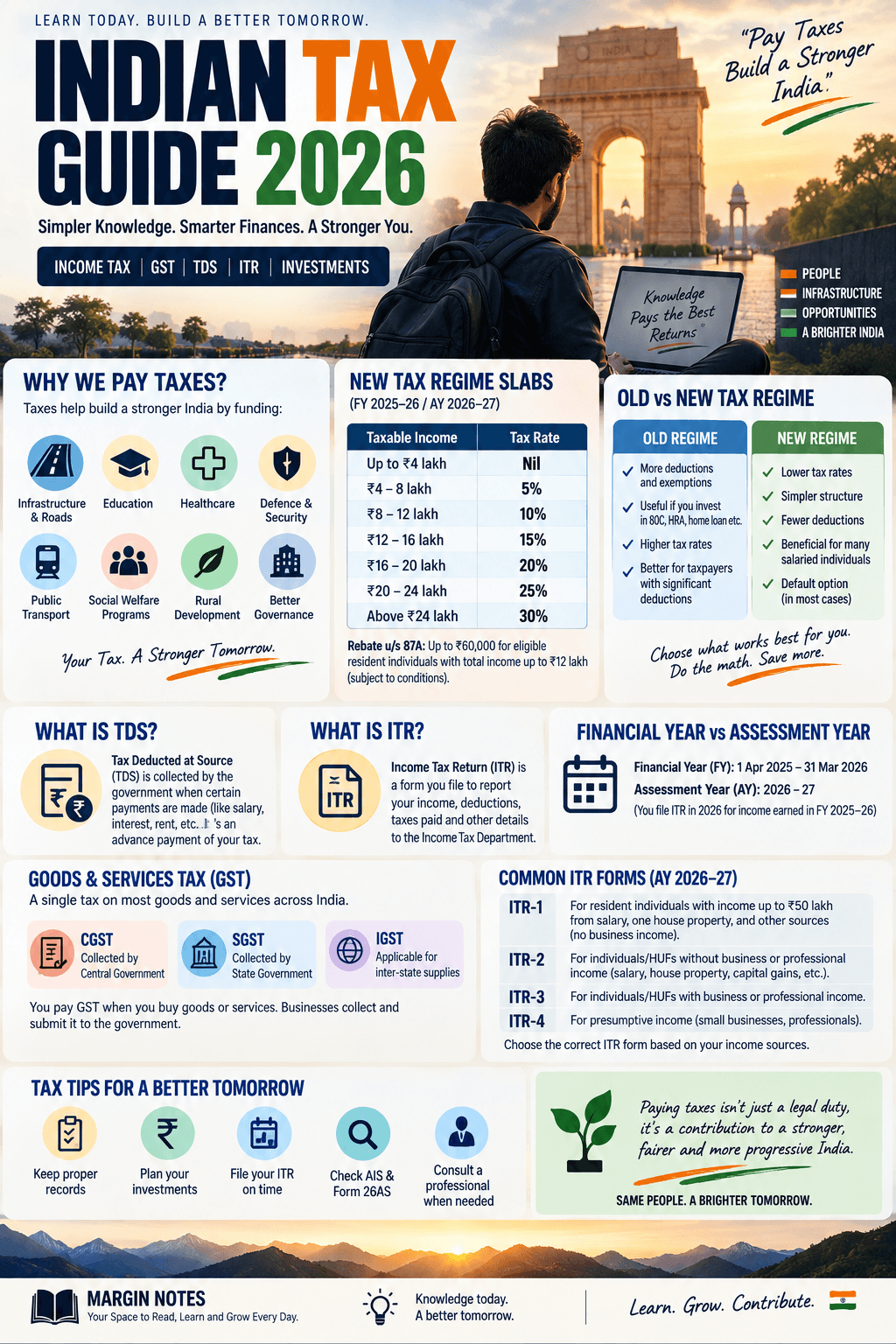
Income Tax, GST, Tax Slabs & ITR — Explained Simply
Updated: September 2026
Taxes.
We hear about them every year.
Income Tax. GST. TDS. ITR. 80C. Old Regime. New Regime.
But if you're receiving your first salary, freelancing, running a small business, or starting a company, India's tax system can initially feel complicated.
The good news?
You don't need to be a Chartered Accountant to understand the basics.
Let's break down Indian taxation in simple language.
💰 First: Why Do We Pay Taxes?
Imagine India as one enormous organization serving more than a billion people.
The government needs money to fund things such as:
🏥 Public healthcare
🛣️ Roads and infrastructure
🚆 Railways
🎓 Education
🛡️ Defence
🚓 Police and public administration
🌾 Government programmes
🏗️ Infrastructure development
Taxes are one of the government's major sources of revenue.
Broadly, taxes can be understood as:
1️⃣ Direct Taxes
Paid directly by the taxpayer.
Examples:
Income Tax
Corporate Tax
2️⃣ Indirect Taxes
Collected when goods or services are supplied or consumed.
The most familiar example is:
GST — Goods and Services Tax
🧑💼 What Is Income Tax?
Income tax is a tax imposed on taxable income.
For individuals, income can come from different sources.
Examples include:
💼 Salary or pension
🏠 House property
📈 Capital gains
🏦 Interest and other income
💻 Business or professional income
The Income Tax Department classifies income under specific heads, and the applicable calculation depends on the nature of that income.
📅 Financial Year vs Assessment Year
This confuses many first-time taxpayers.
Suppose you earned income between:
1 April 2025 and 31 March 2026
That period is:
Financial Year 2025–26
The corresponding return is filed for:
Assessment Year 2026–27
The Income Tax Department confirms that income earned during FY 2025–26 is reported for AY 2026–27.
From the 2026–27 period, taxpayers also need to be aware of the transition to the newer Income Tax Act framework, while AY 2026–27 returns remain governed by the Income-tax Act, 1961.
🆕 New Tax Regime — FY 2025–26
For AY 2026–27, the new-regime slabs are:
Taxable Income Tax Rate
Up to ₹4 lakh Nil
₹4–8 lakh 5%
₹8–12 lakh 10%
₹12–16 lakh 15%
₹16–20 lakh 20%
₹20–24 lakh 25%
Above ₹24 lakh 30%
These are slab rates, meaning the relevant rate applies only to the portion of income falling within each slab—not your entire income.
🎉 Is Income Up to ₹12 Lakh Really Tax-Free?
This is where many people become confused.
Under the new regime, eligible resident individuals can receive a Section 87A rebate of up to ₹60,000 when total income does not exceed ₹12 lakh, subject to the applicable rules.
That can reduce the normal income-tax liability to zero at that income level.
But this should not be interpreted as:
“India has a ₹12 lakh zero-tax slab.”
It doesn't.
The basic nil-rate slab is ₹4 lakh.
The zero-tax outcome up to ₹12 lakh for eligible taxpayers results from the Section 87A rebate.
Certain income taxed at special rates can also require separate treatment, so individual circumstances matter.
💼 What About Salaried Employees?
Salaried employees under the new regime can also benefit from the applicable standard deduction.
This is why you may hear statements about salaried taxpayers having no normal income-tax liability at an income level above ₹12 lakh.
However, your actual tax depends on the composition of your income and eligibility for deductions/rebates.
Always calculate using your actual circumstances rather than relying only on social-media headlines.
🏛️ Old Tax Regime vs New Tax Regime
India still provides eligible taxpayers with a choice between the two systems in relevant cases.
🆕 New Regime
Generally offers:
✅ Wider/lower progressive slab structure
✅ Simpler calculation
✅ Fewer deductions/exemptions
🏛️ Old Regime
Uses the older slabs but allows various deductions and exemptions where conditions are satisfied.
Examples can include:
🏠 HRA-related exemption
💰 Section 80C deductions
🏥 Certain health-insurance deductions
🏡 Eligible home-loan benefits
For taxpayers with business/professional income, the rules for switching regimes are more restrictive than for many non-business taxpayers.
Which one is better?
There isn't one answer for everybody.
You need to calculate both based on:
Income + deductions + exemptions + investments + other income
and compare the resulting liability.
🧾 What Is TDS?
TDS = Tax Deducted at Source.
Instead of waiting until the end of the year to collect all tax, tax may be deducted when certain payments are made.
For example, an employer may deduct tax from an employee's salary and deposit it with the government.
TDS can also apply to specified:
🏦 Interest payments
🏠 Rent
💼 Professional payments
📄 Contract payments
💰 Commissions
Think of TDS as:
Tax collected in advance at the source of certain income.
Importantly, TDS deducted does not necessarily equal your final tax liability.
When you file your return, the final calculation determines whether you:
owe additional tax
or
are eligible for a refund.
📄 What Is an ITR?
ITR = Income Tax Return.
It is the return through which taxpayers report applicable information such as:
Income
Deductions
Taxes already paid
TDS
Capital gains
Other required disclosures
Different ITR forms exist for different taxpayers.
For example, for AY 2026–27, ITR-1 can apply to eligible resident individuals with total income up to ₹50 lakh from specified sources, subject to exclusions and conditions.
ITR-2 can apply to individuals/HUFs without business or professional income who have sources such as salary, house property, capital gains or other income.
Choosing the correct ITR matters.
💸 What Is an Income-Tax Refund?
Suppose your employer/bank deducted:
₹50,000 TDS
But after completing your tax calculation, your final liability is:
₹35,000
The excess:
₹15,000
may become refundable, subject to processing and verification.
That's why reviewing your TDS and filing an accurate return matters.
🏦 What Is Form 16?
For many salaried employees, Form 16 is an important tax document.
It is generally provided by the employer where applicable and contains information relating to salary and TDS.
Employees often use it while preparing their income-tax return.
But don't rely exclusively on Form 16.
Also review information available through documents such as:
AIS — Annual Information Statement
and
Form 26AS
These can help you identify income and tax information reported to the government.
🛒 Now Let's Understand GST
Income tax is based on income.
GST works differently.
GST = Goods and Services Tax
When you purchase many goods or services, GST may be included in the price.
For example:
You purchase a taxable service costing:
₹1,000
If the applicable GST rate were 18%:
GST = ₹180
Total = ₹1,180
The business collects the tax and handles the required GST compliance and payment to the government.
🧾 CGST, SGST and IGST
You may have noticed these terms on invoices.
CGST
Central Goods and Services Tax
SGST
State Goods and Services Tax
For many intra-state transactions, GST is split between CGST and SGST.
For example, if an applicable rate is 18%, it might appear as:
9% CGST
9% SGST
For qualifying inter-state supplies, you may instead see:
IGST
Integrated Goods and Services Tax
The exact GST treatment depends on the supply, place-of-supply rules, registration status and other factors.
🏢 Taxes Become More Important When You Start a Business
Once you become a founder, freelancer or business owner, taxation becomes part of your operating system.
Depending on your business, you may need to understand:
📊 Income tax
🧾 GST
💸 TDS
📑 Tax invoices
🏦 Advance tax
📚 Accounting and bookkeeping
🏢 Corporate tax
📋 Tax returns and compliance
This is why businesses need proper accounting from the beginning.
Don't wait until tax season to organize twelve months of transactions.
💻 What About Freelancers?
Freelancing income is generally not treated exactly like an employee's salary.
Depending on the nature of the work, it may fall under income from business or profession.
That means freelancers should maintain proper records of:
Revenue
Business expenses
Invoices
TDS
Bank transactions
GST, where applicable
Advance tax, where applicable
If you earn money through:
💻 Freelancing
🎥 Content creation
🤝 Consulting
📱 Digital services
🌐 Web development
📣 Marketing services
don't assume tax doesn't apply simply because you aren't a traditional employee.
📈 What About Stocks and Investments?
Investment income can have separate tax treatment.
For example:
📈 Shares
📊 Mutual funds
🏠 Property
💰 Dividends
🏦 Interest
may not all be taxed in exactly the same way as salary.
Capital gains rules can depend on factors such as:
Type of asset
Holding period
Nature of transaction
Applicable tax provisions
This is an area where blindly applying your salary tax slab can produce the wrong answer.
⚠️ A Common Misunderstanding About Tax Slabs
Imagine your taxable income crosses into the 20% slab.
Some people think:
“Now my entire income is taxed at 20%!”
That's not how progressive slab taxation normally works.
Different portions of your taxable income are taxed according to the applicable slabs.
Think of your income like climbing stairs.
Each step has its own tax rate.
You don't suddenly apply the highest step's rate to everything below it.
📊 A Simple Tax Flow
Your personal income-tax calculation can be thought of roughly as:
💰 Earn Income
↓
📊 Classify Different Sources of Income
↓
➖ Apply Eligible Exemptions/Deductions
↓
🧮 Determine Taxable Income
↓
📈 Apply Applicable Tax Rates
↓
🎁 Apply Eligible Rebate/Relief
↓
➕ Add Applicable Surcharge/Cess
↓
➖ Account for TDS / Advance Tax / Other Taxes Paid
↓
📄 File ITR
↓
💰 Pay Balance Tax OR Receive Eligible Refund
That's the basic idea.
🚨 Common Tax Mistakes
Avoid these mistakes:
❌ Ignoring income from side projects
❌ Assuming TDS means your entire tax responsibility is finished
❌ Selecting the wrong ITR
❌ Forgetting investment income
❌ Claiming deductions without documentation
❌ Mixing personal and business transactions
❌ Ignoring AIS/26AS discrepancies
❌ Filing after applicable deadlines
❌ Trusting random social-media tax advice
❌ Waiting until the last day to organize your records
For AY 2026–27, for example, the Income Tax Department states a 31 August 2026 due date for ITR-4, and late filing can involve a fee of up to ₹5,000 plus applicable interest.
Deadlines vary by taxpayer category, so always check the date applicable to you.
🧠 **Tax Planning Is Not Tax Evasion
**
There is an important difference.
✅ Tax Planning
Using legal deductions, exemptions and structures available under the law to manage tax efficiently.
❌ Tax Evasion
Hiding income, creating false expenses or deliberately providing incorrect information to avoid tax.
One is legitimate financial planning.
The other can result in penalties and legal consequences.
🌱 Why Young People Should Learn Tax Early
If you're 20–30 years old, tax may seem boring.
But understanding it early can save you:
💰 Money
⏰ Time
😰 Stress
📄 Compliance problems
And as your income grows, tax planning becomes increasingly important.
Don't wait until you're earning ₹20 lakh, ₹50 lakh or running a company to understand taxation.
Learn the basics with your first salary.
🚀 The Bigger Lesson
Understanding tax isn't only about paying the government.
It's part of understanding money itself.
Learn:
How to earn money.
How to save money.
How to invest money.
How taxes affect money.
How to protect money legally.
How to build wealth responsibly.
Financial literacy isn't just about becoming rich.
It's about making informed decisions.
**
❤️ Final Thought
Your first salary teaches you how to earn.
Your first investment teaches you how money can grow.
Your first tax return teaches you something equally important:
Earning money comes with financial responsibility.
You don't need to memorize every section of Indian tax law.
You just need to understand enough to ask the right questions, maintain proper records, recognize when professional advice is needed, and make informed financial decisions.
Earn. Save. Invest. Understand your taxes. Build responsibly. 🇮🇳
✍️ Margin Notes
Read. Learn. Think. Create.
This article is for general educational purposes and is not personalized tax advice. Indian tax rules depend on the taxpayer, type of income and financial year. Verify current rules with the Income Tax Department or a qualified tax professional before making tax decisions.
0 Comments
Log in to leave a comment.